Predictions for when to measure plasma lines
There is thus much to be gained from an increased use of plasma lines especially for the possibility to measure field aligned currents, where the remaining theoretical uncertainties can only be resolved by further measurements. It is then very valuable to be able to choose those circumstances when plasma line measurements are possible. We have used state of the art model calculations of the superthermal electron distribution for both sunlit and nighttime auroral conditions, and calculated the expected plasma line intensity for different radars (i.e. different transmitter frequencies) and different conditions.The calculated plasma line intensities have also been used to predict the actual signal to noise ratio for different radars, to give a guide to when plasma line measurements should be made with the different radars. The predictions for different radars can be found here:
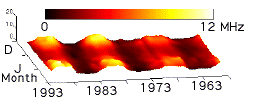
For comparison, we also show a plot of the midday F-region peak plasma frequency from Kiruna ionograms for 30 years. The seasonal and solar cycle dependance is very clear. For the EISCAT UHF and Søndre Strømfjord incoherent scatter radars solar maximum conditions are needed for good plasma line measurements. At other times, the lower frequency radars are to be preferred.
Publications
Kirkwood, S., H. Nilsson, J. Lilensten, M. Galand, Strongly enhanced incoherent-scatter plasma lines in aurora, J. Geophys. Res.,100, 21343-21355, 1995Nilsson, H., Kirkwood, S., Bjørnå, N., Bistatic measurements of incoherent-scatter plasma lines, J. Atmos. Terr. Phys., 58, 175-187, 1996
Nilsson, H., S. Kirkwood, J. Lilensten, M. Galand, Enhanced incoherent scatter plasma lines, Ann. Geophys, 14, 1462-1472, 1996